Disclosure: This post may contain affiliate links. We may earn a small commission at no extra cost to you if you make a purchase through these links. Please read our full Disclaimer for more details.
While K-Beauty put poreless, mirror-shiny “glass skin” on the global map, Japanese beauty traditions quietly prize a softer, more touchable ideal: skin that feels as plump, supple, and pillowy as freshly pounded rice cake. Known across Tokyo beauty counters as Japanese mochi skin (mochi-hada), this coveted complexion isn’t about looking slick or overly dewy under bright lights. Instead, it centers on deep, resilient hydration and a velvety-smooth surface that bounces back effortlessly when you touch your cheek. Rooted in the gentle, friction-free rituals popularized by acclaimed Japanese aesthetician Chiharu, achieving this baby-soft glow requires far fewer steps—and far less irritation—than most Western routines.
What Is Japanese Mochi Skin (and the Chiharu Philosophy)?
Walk into any drugstore or luxury department counter in Tokyo, and you won’t find shelves dominated by harsh 30-percent acid peels or gritty walnut scrubs. Traditional J-Beauty revolves around Japanese mochi skin, a concept built on nourishing the outermost layer of your skin (the stratum corneum) so thoroughly that fine dehydration lines plump up naturally from within.
This approach ties closely to the minimalist, touch-focused philosophy championed by Japanese beauty expert Chiharu, whose techniques emphasize treating facial skin like delicate silk. Instead of aggressive resurfacing, chiharu skin principles prioritize three simple pillars:
- Zero Mechanical Friction: Never tug, rub, or scrub your face with rough washcloths, cleansing brushes, or heavy fingertips.
- Water-First Layering: Drench the skin in humectant-rich watery lotions before applying any oils or heavy creams.
- Warmth and Hand-Pressing: Use the natural heat of your palms to press products gently into the skin, encouraging circulation without stretching delicate tissue.
When you follow a consistent mochi hada routine, your skin barrier stays calm, intact, and visibly cushioned rather than shiny or stripped.
Glass Skin vs. Mochi Skin: Which Glow Fits Your Skin Best?
Both trends celebrate healthy, well-hydrated skin, yet comparing glass skin vs mochi skin reveals two very different textures and maintenance styles:
- Glass Skin (K-Beauty): Focuses on a high-shine, translucent surface that reflects light almost like wet glass. Achieving it typically involves frequent chemical exfoliation, pore-refining toners, and multiple thin layers of lightweight essences and facial oils.
- Mochi Skin (J-Beauty): Focuses on matte-plump softness—like a lightly dusted marshmallow or soft mochi pastry. The surface looks smooth, natural, and pore-refined rather than slick, while the deeper layers hold abundant water.
If you have dry, reactive, mature, or barrier-compromised skin that flushes easily from strong retinoids or exfoliating acids, mochi skin offers a far more forgiving—and sustainable—path to radiance.
The 5-Step Japanese Skincare Routine for Baby-Soft Mochi Skin
You do not need ten different serums to build an effective japanese skincare routine for glowing skin. Every step below serves one clear purpose: cleanse without stripping, flood the skin with water, and seal that moisture safely inside.
Step 1: Friction-Free Double Cleansing
Makeup, excess sebum, and city pollution sit on the surface in oil-soluble layers, while sweat and dust are water-soluble. Scrubbing them off with a single harsh foaming wash leaves your face tight and squeaky—the exact opposite of supple mochi texture.
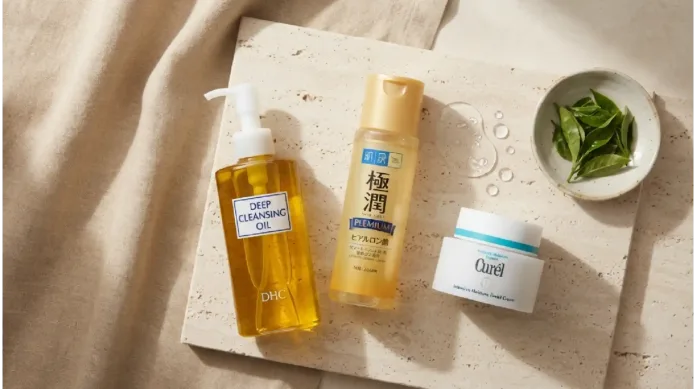
Start your evening with an olive-oil-based cleanser that melts away waterproof sunscreen effortlessly without tugging. Massaging a few pumps of DHC Deep Cleansing Oil onto dry skin for thirty seconds lifts stubborn impurities cleanly, rinsing away with lukewarm water without leaving a heavy film. Follow with a whipped, cushiony foaming wash—rolling the foam between your palms and your face so your fingers barely touch your skin.
Step 2: Flood Damp Skin with a Japanese Hydrating Lotion
In Japan, the word “lotion” (kesho-sui) does not refer to a thick body cream. It means a watery, essence-like hydrating toner designed to prep and saturate freshly washed skin within seconds of patting your face dry.
Choosing the best japanese hydrating toner comes down to multi-weight hyaluronic acid and fermented humectants that pull water deep into parched cells. Pouring a quarter-sized puddle of Hada Labo Gokujyun Premium Hyaluronic Acid Lotion into your palms and pressing it gently onto damp skin delivers seven different weights of hyaluronic acid, instantly transforming tight, papery skin into a bouncy, cushioned canvas.
Step 3: The 3-Minute Japanese “Lotion Masking” Trick
If your skin feels rough, flaky, or dull before an event, skip the harsh scrub and try lotion masking japanese skincare—a beloved technique made famous by Japanese beauty legends Chizu Saeki and Chiharu.
Here is how to do it in three minutes flat:
- Take two or three thin, peelable cotton pads and dampen them lightly with filtered water so they don’t waste product.
- Saturate the cotton pads generously with a ceramide- and amino-acid-rich Japanese lotion until dripping wet.
- Peel the pads into thin layers and lay them flat across your forehead, cheeks, and chin like a custom sheet mask.
- Remove them after exactly three minutes—before the cotton begins drying out and pulling moisture back from your face.
Using a large-format, sake-infused formula like Kikumasamune High Moist Skin Care Lotion makes daily lotion masking effortless and budget-friendly, leaving cheeks noticeably brighter, calmer, and baby-soft in minutes.
Step 4: Soften with a Weightless Emulsion (Nyueki)
Once your skin is saturated with watery hydration, Japanese routines introduce a milky emulsion (nyueki). Think of emulsion as a fluid, lightweight moisturizer that bridges the gap between water and oil, softening the upper keratin layer so skin feels velvety rather than sticky. Warm a dime-sized amount between your hands and press it gently from the center of your face outward.
Step 5: Seal Moisture with Ceramides and Daily SPF
Water evaporates quickly if you leave it unsealed—a process dermatologists call transepidermal water loss. Lock in all your hydration layers with a rich, non-comedogenic barrier cream packed with ceramides, the natural lipids that hold skin cells together like mortar between bricks. Smoothing a layer of Curel Intensive Moisture Facial Cream over your face at night cushions dry areas and supports overnight barrier recovery without feeling heavy or greasy.
In the morning, swap heavy occlusives for a breathable Japanese sunscreen so UV rays never break down your natural collagen or dry out your complexion. Applying Biore UV Aqua Rich Watery Essence SPF 50+ as your final morning step gives you high-level broad-spectrum protection in a cooling, water-capsule texture that keeps skin plump under makeup.
Daily Japanese Lifestyle Habits That Support Mochi Skin
True to the holistic philosophy that genuine radiance starts from within, Japanese beauty rituals extend well beyond bathroom bottles. Pairing smart topical hydration with simple daily habits accelerates your results:
- Ditch the Reusable Bath Towel: damp bathroom towels harbor bacteria and rough cotton fibers that create micro-friction. Pat your face dry gently with a fresh, soft disposable facial tissue instead.
- Avoid Steaming-Hot Showers on Your Face: Hot water strips protective surface lipids in seconds. Rinse your face separately at the sink using cool or barely lukewarm water.
- Nourish Your Skin Barrier from the Inside: Traditional Japanese diets naturally support skin elasticity through antioxidant-rich green tea (matcha and sencha), omega-3-rich wild fish, and fermented staples like miso and natto that promote gut-skin balance.
Consistency beats intensity every time. Practicing gentle, friction-free Japanese mochi skin habits for just two weeks produces a softer, calmer complexion than an aggressive, complicated routine ever could.
The Bottom Line on Cultivating Baby-Soft Skin
Achieving luminous, resilient skin does not require harsh acids, burning tingling sensations, or a ten-step shelf of conflicting actives. When you strip away unnecessary friction, drench your skin in multi-weight hydrating lotions, and seal everything in with ceramides and daily sunscreen, Japanese mochi skin becomes an effortless everyday reality. Treat your skin with quiet patience, press your products in with warm hands, and let natural hydration do the heavy lifting.